Saturday, October 29, 2011

Information retrieval behavior

Information retrieval behavior

The “need” for information can be caused by four types of modes (Vandenbosch, 1997). When managers have no intention or specific purpose to find anything and are just viewing some data it is called undirected viewing or scanning which is often the case in the first sub phase of the decision making process. This is similar to undirected surfing on the internet. At the extreme other end of the continuum, we find the formal search mode which is “a deliberate effort to find a piece of information” (Aquilar, 1967). This is also referred to as focused searching.

Sunday, October 23, 2011

A general task model of the decision making process

What process should business intelligence software support? 

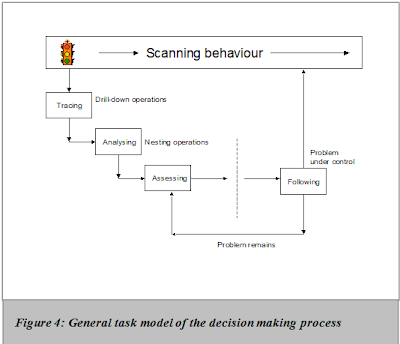
The succession of steps that managers perform when they are engaged in the intelligence phase (see Turban, 1993) using a business intelligence system, can be generalized as a set of strategies that make up a general task model of the senior manager when involved in a decision making process. This general task model of the decision making process accommodates the procedure discovered by Borgman. That procedure shows that managers are engaged initially in broad and systematic browsing (the checklist scanning approach) and focus, in a later stage, based on the results of the scan with large conceptual distances between successive queries (Borgman, 1994). This checklist scanning approach can be extended and translated into the following successive steps.


Thursday, October 13, 2011

Decision making

Decision making

In order to be a successful “driver of the car”, the manager should make deliberate and accurate decisions. Such decisions should be undertaken when the organisation is not running properly in any way. The manager should “steer the wheel” and ask himself continually “Should I turn left now, or can I drive the car forward for a while and then turn to the left? “. These questions remind us that making no decision will also be a decision. To make proper decisions, managers ask for current and reliable management information.

Saturday, October 1, 2011

The basic cycle of the management process

The basic cycle of the management process


The management process is performed within a generic cycle of five steps (Mintzberg, 1975):

  1. Planning, budgeting and setting norms;
  2. Organizing;
  3. Coordinating;
  4. Deciding;
  5. Controlling.

What managers actually do


These steps tell us little about what managers are actually doing and how they are doing it. Without such concrete information, we are not able to design and build planning or information systems that are dedicated to managers (Mintzberg, 1975); neither are we able to define a knowledge-based system that assists in building the interface of such systems. Although this cycle is very unspecific it deserves clarification and discussion related to the user interface of business intelligence systems.

Saturday, September 24, 2011

General responsibilities of management

In his book ‘Management, tasks, responsibilities and practices’ Peter Drucker describes that “management and managers are the specific need of all institutions, from the smallest to the largest. They are the specific organs of every institution.

Sunday, August 14, 2011

Management & decision making

Managers perform their tasks and responsibilities within cybernetic systems called organizations. They are the proposed users of business intelligence systems. In order to design interfaces for business intelligence systems fully dedicated to the needs and world of the manager, we should gain more insight into their work.

Tuesday, August 2, 2011

Variations between structure and process

In the previous blog, I have mentioned two major significant, interrelated distinctions that may vary according to the data the manager requests. The manager sometimes wishes to look through glasses that reveal the process oriented view and at other times, he wants to view the data in a more structural way (Tideman, 1993).