Showing posts with label business intelligence systems. Show all posts

Monday, December 12, 2011

Managers are often disturbed, have a preference for live action and deal with problems as a network of connected problems

Managers are often disturbed, have a preference for live action and deal with problems as a network of connected problems

Managers are very frequently interrupted by sub-ordinates and others (Mintzberg, 1973). Interruption causes the manager to focus his attention on another issue and therefore when the manager returns to the business intelligence system, whatever the time between, the business intelligence system should always remain in the state which it was in when the manager left it. If the manager was engaged in a planning task, the business intelligence system should refresh itself with the planning window. It should even give managers information about the completion of the sub tasks and provide them with the opportunity to proceed with the task. To decide to give an overview or not can be based on the time the manager was away. If the manager will complete with the task within a few hours, the system can present such an overview. If he succeeds within minutes, such an overview would not be convenient.

Saturday, December 3, 2011

Work characterized by brevity, variety and fragmentation

Work characterized by brevity, variety and fragmentation

Brevity, variety and fragmentation further characterize the work of the manager. On average, their telephone calls last for 6 minutes, desk work for 15 minutes and scheduled meetings, the most time consuming, last for an average of 68 minutes (Mintzberg, 1973). In addition, the job of the manager demonstrates little routine and the tasks they perform are often not repetitive. They rarely face the same decision or situation twice.

Saturday, November 26, 2011

Managers have a considerable workload

Managers have a considerable workload

In their work, managers display some typical characteristics that are significant and relevant in relation to the design of the business intelligence systems they use. Other people, situated in the lower regions of the organization require also business intelligence systems but such systems are different in several ways. The type, the structure and the nature of managerial tasks as well as the working environment can play a significant role in relation to the user interface design of business intelligence solutions.

Sunday, October 23, 2011

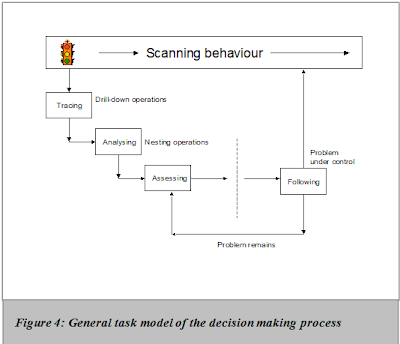
A general task model of the decision making process

What process should business intelligence software support? 

The succession of steps that managers perform when they are engaged in the intelligence phase (see Turban, 1993) using a business intelligence system, can be generalized as a set of strategies that make up a general task model of the senior manager when involved in a decision making process. This general task model of the decision making process accommodates the procedure discovered by Borgman. That procedure shows that managers are engaged initially in broad and systematic browsing (the checklist scanning approach) and focus, in a later stage, based on the results of the scan with large conceptual distances between successive queries (Borgman, 1994). This checklist scanning approach can be extended and translated into the following successive steps.


Saturday, October 1, 2011

The basic cycle of the management process

The basic cycle of the management process


The management process is performed within a generic cycle of five steps (Mintzberg, 1975):

  1. Planning, budgeting and setting norms;
  2. Organizing;
  3. Coordinating;
  4. Deciding;
  5. Controlling.

What managers actually do


These steps tell us little about what managers are actually doing and how they are doing it. Without such concrete information, we are not able to design and build planning or information systems that are dedicated to managers (Mintzberg, 1975); neither are we able to define a knowledge-based system that assists in building the interface of such systems. Although this cycle is very unspecific it deserves clarification and discussion related to the user interface of business intelligence systems.

Saturday, September 24, 2011

General responsibilities of management

In his book ‘Management, tasks, responsibilities and practices’ Peter Drucker describes that “management and managers are the specific need of all institutions, from the smallest to the largest. They are the specific organs of every institution.

Sunday, August 14, 2011

Management & decision making

Managers perform their tasks and responsibilities within cybernetic systems called organizations. They are the proposed users of business intelligence systems. In order to design interfaces for business intelligence systems fully dedicated to the needs and world of the manager, we should gain more insight into their work.

Monday, July 25, 2011

Processes and business intelligence systems

Organizations accomplish their goals within the organizational structure by processing input into output in order to generate business and fulfill the needs of their customers . An organizational process is a collection of activities that is performed in order to reach a certain organizational goal or business objective (operational, strategic, tactical).

This transformation process adds a margin of value (referred to as the value chain model), enriches input and processes the input in a way that the output is more valuable compared to the input (Porter, 1985).

Wednesday, July 6, 2011

The organization as cybernetic system

Managing is a complex process that can be compared to driving a car. We use a car to get us to work and we use the steering wheel, the accelerator pedal, the brakes and the gears while taking care that the motor system keeps working properly. At the same time, we pay attention to other traffic users in order to anticipate quickly on situations that might bring us otherwise in trouble.

Tuesday, July 5, 2011

Definitions: organizations and goals

An organization is a steady, formal and social structure that takes resources from the environment and processes them to produce output (Laudon, 1997).