Showing posts with label analytical operations. Show all posts

Saturday, June 6, 2015

Criteria of expressiveness of the data

Criteria of expressiveness of the data

Variations that should be used for designing expressive graphs and satisfying the users information needs, should at least consider the following data characteristics (Roth and Mattis, 1998b):

Friday, July 12, 2013

Categories of a dimension

Categories of a dimension

At run time, a dimension is filled with categories. The number of categories can be an indication to:
  • Present a different type of graph;
  • Decide to use replacement instead of insertion of the categories of the level below;
  • Split the categories automatically into smaller groups.
If the number of categories exceeds the limit of 6, a pie chart would be inappropriate (Zelazny, 1996) or the rest of the categories should taken together in a single group ‘Other...’. Moreover, pie charts cannot be used if among the categories there are positive as well as negative numbers. In that case, a bar chart is a better choice.

Saturday, June 15, 2013

Dimensions of a measure

Dimensions are points of view from where a user can look at the measures stored in the cube. They form the structure of the multidimensional model. A measure without dimensions does not make sense. This can be compared with a record with numbers having no corresponding primary key attributes or secondary explanatory data attributes. It is important, as indicated by the title of this blog, to allocate measures to a dimension, because not all measures do hold sensible values for a dimension.

Sunday, October 23, 2011

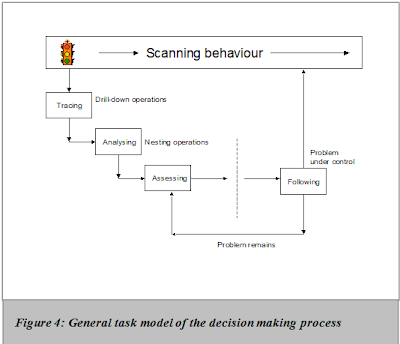
A general task model of the decision making process

What process should business intelligence software support? 

The succession of steps that managers perform when they are engaged in the intelligence phase (see Turban, 1993) using a business intelligence system, can be generalized as a set of strategies that make up a general task model of the senior manager when involved in a decision making process. This general task model of the decision making process accommodates the procedure discovered by Borgman. That procedure shows that managers are engaged initially in broad and systematic browsing (the checklist scanning approach) and focus, in a later stage, based on the results of the scan with large conceptual distances between successive queries (Borgman, 1994). This checklist scanning approach can be extended and translated into the following successive steps.