Showing posts with label decision making process. Show all posts

Saturday, June 6, 2015

Effectiveness criteria for data visualization

Effectiveness criteria for data visualization

According to research performed by Cleveland and McGill there is a difference in the accuracy in quantitative, ordinal and nominal tasks (Mackinlay, 1986). Higher tasks are accomplished more accurately than lower tasks. Tasks to perceive different positions rank as best and differences in shapes are the perceived as being the worst.

Monday, December 12, 2011

Managers are often disturbed, have a preference for live action and deal with problems as a network of connected problems

Managers are often disturbed, have a preference for live action and deal with problems as a network of connected problems

Managers are very frequently interrupted by sub-ordinates and others (Mintzberg, 1973). Interruption causes the manager to focus his attention on another issue and therefore when the manager returns to the business intelligence system, whatever the time between, the business intelligence system should always remain in the state which it was in when the manager left it. If the manager was engaged in a planning task, the business intelligence system should refresh itself with the planning window. It should even give managers information about the completion of the sub tasks and provide them with the opportunity to proceed with the task. To decide to give an overview or not can be based on the time the manager was away. If the manager will complete with the task within a few hours, the system can present such an overview. If he succeeds within minutes, such an overview would not be convenient.

Saturday, October 29, 2011

Information retrieval behavior

Information retrieval behavior

The “need” for information can be caused by four types of modes (Vandenbosch, 1997). When managers have no intention or specific purpose to find anything and are just viewing some data it is called undirected viewing or scanning which is often the case in the first sub phase of the decision making process. This is similar to undirected surfing on the internet. At the extreme other end of the continuum, we find the formal search mode which is “a deliberate effort to find a piece of information” (Aquilar, 1967). This is also referred to as focused searching.

Sunday, October 23, 2011

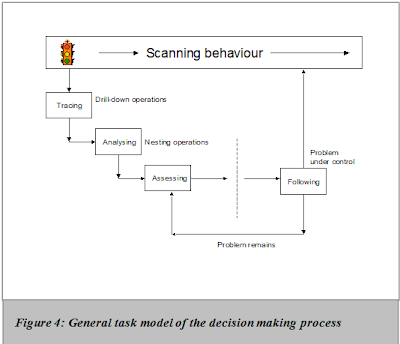
A general task model of the decision making process

What process should business intelligence software support? 

The succession of steps that managers perform when they are engaged in the intelligence phase (see Turban, 1993) using a business intelligence system, can be generalized as a set of strategies that make up a general task model of the senior manager when involved in a decision making process. This general task model of the decision making process accommodates the procedure discovered by Borgman. That procedure shows that managers are engaged initially in broad and systematic browsing (the checklist scanning approach) and focus, in a later stage, based on the results of the scan with large conceptual distances between successive queries (Borgman, 1994). This checklist scanning approach can be extended and translated into the following successive steps.